
Weighted vest returns are rarely about quality. They are about fit. A vest that is one inch too narrow in the chest will not buckle, no matter how good the materials are. A vest that starts too heavy will feel like a punishment, no matter how well it is designed. The frustrating part is that both problems are preventable with about ninety seconds of measurement and one honest decision about starting load.
The first number is chest circumference. This is not the same as your shirt size, and for women, it is not the same as your bra band size. Measure around the fullest part of the chest, tape level under the armpits and across the back, over a t-shirt. Arms down, normal breath[reference:9]. If you wear a bra, use the bust measurement, not the band. A 34 band and a 47 bust describe two different bodies, and a vest closes around the bust[reference:10]. This is why a Zelus weighted vest size chart that lists chest ranges model by model is more useful than a generic S/M/L table. The vest either closes on your frame or it does not; there is no “close enough.”
The second number is body weight, but its role is often misunderstood. Body weight does not determine the vest size directly. It sets a safe starting load. The general guideline is to begin with roughly 5–10% of body weight and increase gradually[reference:11]. For someone at 150 pounds, that is roughly 7.5 to 15 pounds, depending on fitness background and the activity. The mistake is treating this as a target to beat rather than a ceiling to respect for the first few weeks. Weighted walking is low-impact, but it is not “no-impact.” The load accumulates quietly, and the first sign of overdoing it is often a tweak in the lower back or a sore hip the next morning.
This is why adjustable vests are worth considering even if you think you know your number. The weighted walking use case is a good example. Walking is repetitive. A load that feels fine for ten minutes can become a postural problem at forty. An adjustable vest lets you start at the low end, stay there for two to three weeks, and add weight only when your stride and recovery feel unchanged[reference:12]. Fixed-weight vests are simpler and often cheaper, but they assume you already know your number. Most people do not.

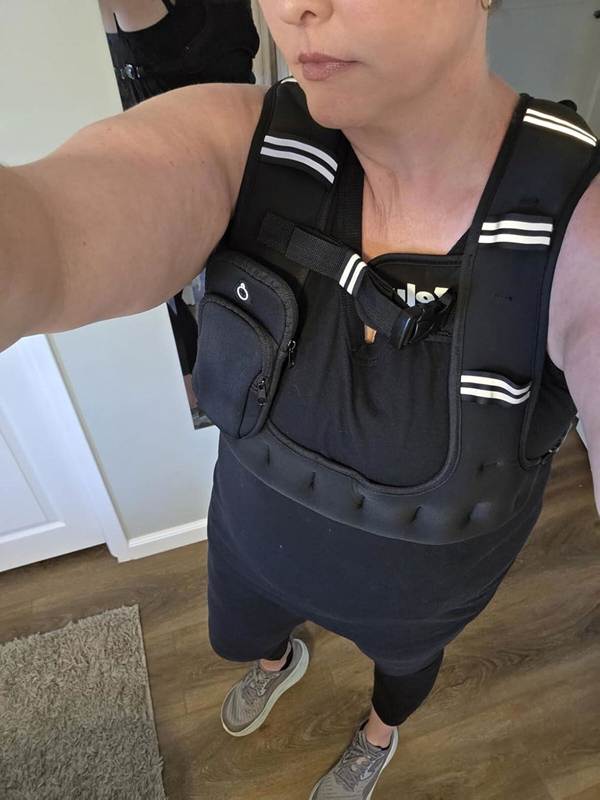
There is also a shape variable that sizing charts cannot fully capture. Two people with the same chest measurement may fit differently in a U-shape versus an X-shape, because the load sits differently on the torso. Zelus’s shape guide exists for this reason: the U-shape relieves chest pressure, the X-shape maximizes arm mobility, and the Y-shape fits like a singlet[reference:13][reference:14]. If you are between sizes, the shape decision may matter more than the size decision. A slightly looser Y-shape that sits well is often more usable than a perfectly “correct” X-shape that digs into the chest.
None of this is complicated, but it is easy to skip. The Zelus Fitness fit finder is built around these two numbers because they are the only two that reliably predict whether a vest will be worn or returned. Measure once, choose a shape that matches your body and your primary activity, and start lighter than you think you need. That is the entire formula.