

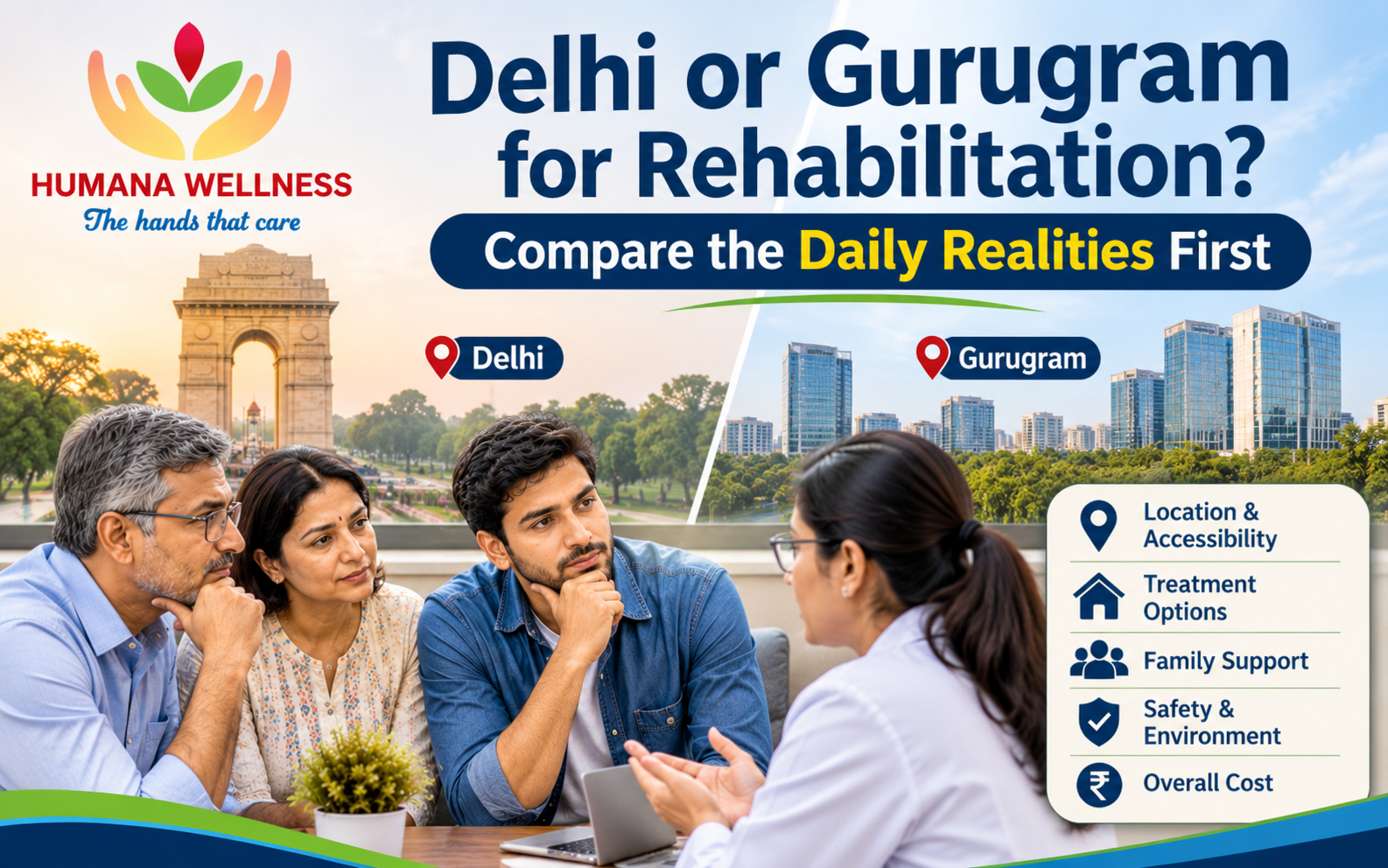
Two centres may offer similar descriptions of counselling and residential care, yet feel very different to a family after admission. One may be close to the patient’s home but difficult to reach during working hours. Another may be farther away but have a clearer system for family appointments. The city name in the search result cannot settle those questions.
Delhi and Gurugram are linked by daily work, education and family travel. For treatment, that wider NCR connection is useful, but it can also make online listings confusing. A service that works with people from Delhi may operate physically in Haryana. Families should compare the real arrangements rather than treating every listing as a Delhi address.
Compare travel in the situations that matter
For an initial assessment, a family may be willing to travel across NCR once. For several weeks of visits, the same route may become tiring, particularly when relatives are juggling jobs or school timings. Estimate travel from the actual starting point, at the times appointments are likely to take place. Check parking, drop-off arrangements and whether a patient with mobility difficulties can reach the consultation area comfortably.
Someone searching for delhi rehabs may understandably want care within the capital. But proximity to home does not always mean the best fit. Ask what treatment is available, which professionals are involved and whether the level of medical supervision matches the person’s needs before using distance to eliminate options.
If a person requires urgent medical care for seizures, severe confusion, overdose or breathing difficulty, do not use a residential-centre comparison to decide where to go. The nearest suitable emergency medical service takes priority.
A Gurugram listing needs a Gurugram address
The phrase gurgaon rehabs is often used in searches by people who still use the city’s former name. Gurugram and Gurgaon refer to the same city, but neither is part of Delhi city. The linked service’s published location is 1595, Huda Colony, Sector 46, Gurugram, Haryana 122003.
Confirm which facility an appointment refers to. A website, a directory listing and a map result may not always show the same information. Ask whether the residential programme operates at the displayed property and whether outside clinical services are located elsewhere. Clarity about the address helps families plan transport and avoids confusion if the person requires referral or transfer.
It is also worth checking whether the centre serves people from Delhi on the same terms as local residents. Ask about any documentation required for admission, communication arrangements for relatives living farther away and how follow-up care can continue outside Gurugram.
Compare the treatment, not the slogans
A programme’s quality depends on what happens after assessment. Ask who evaluates substance use and mental health, how withdrawal risks are recognised, and how people with medical illnesses are supported. Find out what individual counselling involves, how group sessions are run and whether the centre works with a person’s family where appropriate.
For alcohol and certain sedative dependencies, medical withdrawal management may be necessary and sometimes requires inpatient monitoring. A residential setting offering counselling is not automatically a replacement for a hospital capable of managing serious withdrawal. The team’s explanation of referrals and emergencies is therefore important.
The same care should be taken with drugs. Different substances have different withdrawal and overdose risks. Ask whether treatment addresses the particular substance involved and any accompanying illness, rather than relying on a single programme for everyone.
Compare privacy and contact arrangements
Some people feel relieved to receive care outside their usual neighbourhood. Others find distance unsettling, especially at the beginning of treatment. Neither reaction should be dismissed. Ask the person what would help them feel safe, respected and able to participate in care.
Families should understand who may contact the patient, how private conversations are arranged and how clinical information is shared. Ask if there is a process for discussing concerns without disclosing everything to relatives. A person’s right to confidentiality remains important even when family members pay the treatment fees.
Do not assume that strict restrictions necessarily mean better outcomes. Rules should have an understandable safety or therapeutic purpose. Ask about visiting hours, phone access, complaints and the procedure for requesting a review of the care plan.
The bill may be different from the quoted package
When comparing services, obtain costs in writing and use the same categories for each provider: accommodation, medical assessment, counselling, medicines, tests, outside consultations, emergency transport and additional days. Ask whether prices change with room type or clinical needs. Make sure the terms for early discharge and extensions are understandable.
The cheapest advertised package may exclude important services. An expensive package is not proof of higher clinical quality. The meaningful comparison is between the care offered, the support actually needed and the total likely cost, including travel for relatives.
Plan for home before treatment ends
The person may leave a structured environment and return to stress, easy access to substances, unresolved financial worries or strained family relationships. Ask how the programme prepares people for those changes and whether follow-up sessions can be conducted near home. Clarify who will coordinate with an existing physician if medication continues.
Family participation can often be arranged in more than one way. If repeated travel between Delhi and Gurugram is difficult, ask whether appropriate sessions are offered remotely. Do not assume a centre provides this until it has confirmed the arrangement.
A sensible shortlist has room for both clinical and practical facts. Ask whether the care is appropriate, whether people are treated respectfully, whether costs are clear, and whether travel and aftercare will work for the household. The decision need not be reduced to Delhi versus Gurugram. What matters is whether the service can offer safe, suitable and sustainable support.